From 1 October 2026, building a new home in England comes with an extra bill attached, and it lands squarely on developers.
The 2026 Building Safety Levy is a new charge on most new residential developments, designed to help fund the remediation of historic building safety defects, so leaseholders and taxpayers aren’t left covering the cost of decades-old failures.
If you’ve got schemes in the pipeline for later this year, this is one to get your head around. Then you can plan ahead to make sure you’ve got the right welfare solutions to keep your staff safe.
What is the Building Safety Levy?
The Levy was legislated for under the Building Safety Act 2022, with the detail confirmed in the Building Safety Levy (England) Regulations 2025 which came out in November 2025.
It applies to what the regulations call “major residential development”: schemes of 10 or more new dwellings or 30 or more bedspaces of purpose-built student accommodation. Smaller sites fall outside its scope entirely.
Who Pays the Building Safety Levy?
The developer, not the buyer, not the leaseholder, is liable for the 2026 Building Safety Levy.
Specifically, it’s whoever submits the building control application for the works. Local authorities collect the charge and pass it on to central government, but liability sits with you from the moment your application goes in.
The amount is worked out on gross internal floorspace, including communal areas, multiplied by a rate set per local authority. Rates are weighted to reflect local house prices, so a scheme in Kensington and Chelsea pays a good deal more per square metre than one in County Durham.
Hampshire authorities will each set their own rate, so it’s worth checking the figure for your specific patch rather than assuming a South-wide average.

When Does the New Building Safety Levy Apply?
Only applications submitted on or after 1 October 2026 are caught.
If you’ve already lodged your building control application before that date, you’re in the clear, even if the scheme is later varied or amended. There is no transitional relief and no half-measures here: miss the cut-off, and the Levy applies in full. The one catch is that if an early application is rejected for falling short of standards and has to be resubmitted after 1 October, it becomes liable at that point.
Got a Construction Project Before October?
If you’re racing to get a building control application in ahead of the deadline, the paperwork isn’t the only thing that needs to move fast.
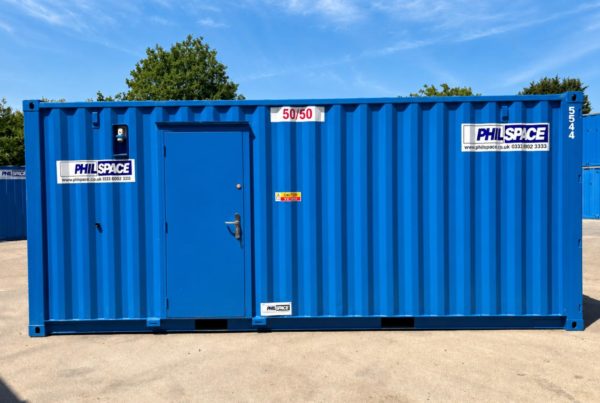
You’ll need site accommodation and welfare units in place the moment work starts. Get in touch on 023 8022 3333 and we’ll have your kit on site while you focus on the application.
Building Safety Levy Exemptions
- Affordable and social housing, including supported housing and accommodation provided by local authorities, housing associations or charities
- Care homes, hospitals, school accommodation, secure residential institutions and hotels
- Children’s homes, domestic abuse shelters and armed forces accommodation
- Developments below the 10-dwelling (or 30-bedspace) threshold
There’s also a category of “exempt person”: non-profit registered providers of social housing and their wholly owned subsidiaries, whose entire application is exempt regardless of the mix of housing involved.
Worth flagging for SMEs working alongside a housing association: for-profit registered providers don’t get this exemption, and a joint venture is only exempt if every party to it qualifies.
How to Prepare for the Building Safety Levy
Get your timing right
If a scheme is genuinely close to submission-ready, getting your building control application in before 1 October avoids the Levy altogether. That’s a real saving worth chasing, but it’s not worth rushing a submission that then gets rejected and pushed past the deadline.
Check your exemption status early
Don’t leave this until the application’s already gone in. If there’s any doubt over whether your scheme, or part of it, qualifies for an exemption, get it confirmed with your local authority beforehand. This matters most on mixed-tenure schemes, where part of the site may be exempt affordable housing and the rest fully chargeable. It’s far easier to sort that split out on paper than to unpick it once you’re mid-build.
Factor it into your appraisals and contracts
Whatever your timeline, build the Levy into your viability appraisals now. Payment falls due once the local authority issues a Levy Liability Notice, usually within five weeks of commencement (eight if there’s a spot check), and it must be settled before any completion certificate is issued. That’s a cash flow point worth discussing with contractors and funders early, not discovering late.
What Happens If You Don’t Pay the Building Safety Levy?
If you don’t pay, you don’t get a completion certificate; it’s as simple as that. Without the certificate, you can’t sell, occupy, or close out warranties on the affected units.
For phased schemes, this can bite even harder, since a completed phase can be held up by an unpaid Levy on the wider application, even if that phase itself is finished and ready to hand over.
It pays to have this on your radar well before practical completion, not the week you need the keys handed over, and to keep your local authority in the loop if there’s any risk of a delay on your end.
Want to Get Your Site Up and Running Before the 2026 Building Safety Levy?
Whatever the 2026 Building Safety Levy means for your numbers, the work of getting a site up and running doesn’t stop. We’ve spent three generations kitting out developments across Hampshire and the South with site accommodation, welfare units and secure storage, so the practical side of your project is sorted while you handle the paperwork.
Give us a call on 023 8022 3333 when you’re ready to get moving, or get in touch online.
FAQs
Who pays the Building Safety Levy?
The developer submitting the building control application is liable for the Building Safety Levy, not the homebuyer or leaseholder. Local authorities collect the charge and pass it to central government to fund building safety remediation.
What developments are exempt from the Building Safety Levy?
Exemptions include affordable and social housing, care homes, hospitals, school accommodation, hotels, and schemes below 10 dwellings (or 30 PBSA bedspaces). Non-profit registered providers of social housing are also classed as exempt persons.
When does the Building Safety Levy come into effect?
The Building Safety Levy comes into force on 1 October 2026 in England. It applies to building control applications submitted on or after that date; applications submitted before it are not liable, even if later varied.